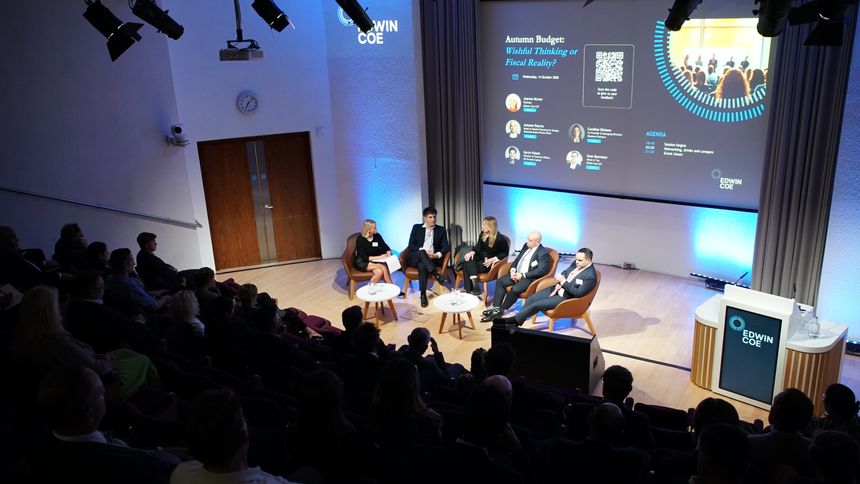

As the Autumn Budget approaches, Edwin Coe’s recent panel event brought together tax, private wealth, policy and entrepreneurial perspectives to consider what the Chancellor may announce and their views on what the UK needs to support growth.
The panel moved quickly beyond predictions to a shared priority, that the UK must create an environment in which people have the confidence to build, invest, grow and commit to the UK.
Below are some of the key takeaways from the discussion.
Tax certainty matters as much as tax rates
One of the strongest themes was the problem of uncertainty. The panel agreed that speculation around Capital Gains Tax (CGT), wealth taxes, inheritance tax and other reforms can influence behaviour long before any policy changes are introduced.
Moving to the Budget itself, Sean Bannister, Head of Tax at Edwin Coe, noted that while targeted tax increases and compliance reforms are likely, the Government's room for significant change remains constrained by its commitments on major taxes. He suggested any CGT increase is more likely to be moderate based on the Chancellor’s reported comments the day before our event.
The panel questioned whether a higher CGT rate would raise additional revenue. Unlike income tax, CGT is highly behavioural. Entrepreneurs can delay exits, investors can defer disposals and internationally mobile individuals can choose where they realise gains.
Antonio Risorto, Head of Wealth Planning for Europe at Deutsche Private Bank, emphasised that stability can matter as much as the rate itself. Entrepreneurs, investors and international families plan over many years, so confidence in the direction of the tax system is critical.
The UK must remain attractive to entrepreneurs and investors
The UK’s ability to retain successful founders and attract the next generation of entrepreneurs and investors was a recurring concern.
Business owners are increasingly seeking advice on relocation as part of their succession and general tax structuring. Tax was felt to be a key driver in these discussions, but not in isolation, the view was also formed that the UK business environment was as important, if not more so, depending on the client profile.
Karim Palant, Director of External Affairs at UK Private Capital, argued that headline rates shape international perceptions of whether the UK welcomes investment. He also pointed to enduring strengths: world-class professional services, deep capital markets, expertise in AI and life sciences, and London’s global financial position.
Drawing on his European wealth-planning perspective, Antonio added that internationally mobile clients assess tax, immigration, investment opportunities and family circumstances together. The challenge is to ensure the UK’s advantages are not obscured by uncertainty.
Simplicity is a competitive advantage
The panel was united on the burden created by tax complexity.
Sean highlighted greater HMRC scrutiny, increased use of automation and AI, and the prospect of higher compliance demands for individuals and businesses.
Caroline Dickens, Co-Founder and Managing Director of Neo Nova Partners, described the practical impact on founders. For smaller and scaling businesses, complex tax and regulatory requirements consume time, money and management attention that could otherwise support growth.
Antonio noted the added complexity for internationally mobile individuals and families with assets, investments or business interests across several jurisdictions. A simpler, more predictable system would strengthen the UK’s competitiveness as a place to live, invest and manage wealth.
Growth needs more than tax policy alone
Tax policy alone cannot deliver growth. The panel also considered immigration, access to capital, investment incentives and pension reform.
Karim highlighted proposals for scale-up reinvestment relief, which could encourage founders who have exited successfully to reinvest their capital and experience in the next generation of UK companies. He also pointed to the potential for UK pension capital to support more start-ups and scale-ups, reduce reliance on overseas funding and help businesses remain in the UK.
Looking beyond the Budget
Despite different views on individual measures, the panel agreed that the UK’s fiscal challenges will not be solved through isolated tax changes. Sustainable growth, investment and productivity are essential.
For Karim, this means policies that reward investment and entrepreneurship. Caroline stressed the need to remove practical barriers to scaling, while Antonio focused on the clarity internationally mobile individuals and families need to make long-term decisions about their wealth, investments and business interests.
Sean concluded that confidence is often the most effective incentive: when people can plan with certainty, they are more likely to commit capital, expand and create jobs.
How Edwin Coe can help
These issues affect business owners, entrepreneurs, investors and international families in different ways. Whether you are considering an exit, preparing for tax reform, reviewing investment structures, relocating to or from the UK, or planning succession, our specialists can help you navigate the changing landscape.
If you would like to discuss any of the themes raised during the panel, please get in touch.