



Nord Stream AG v Lloyd's Insurance Company S.A. & Arch Insurance (EU) DAC [2026] EWHC 1685 (Comm)
The Background
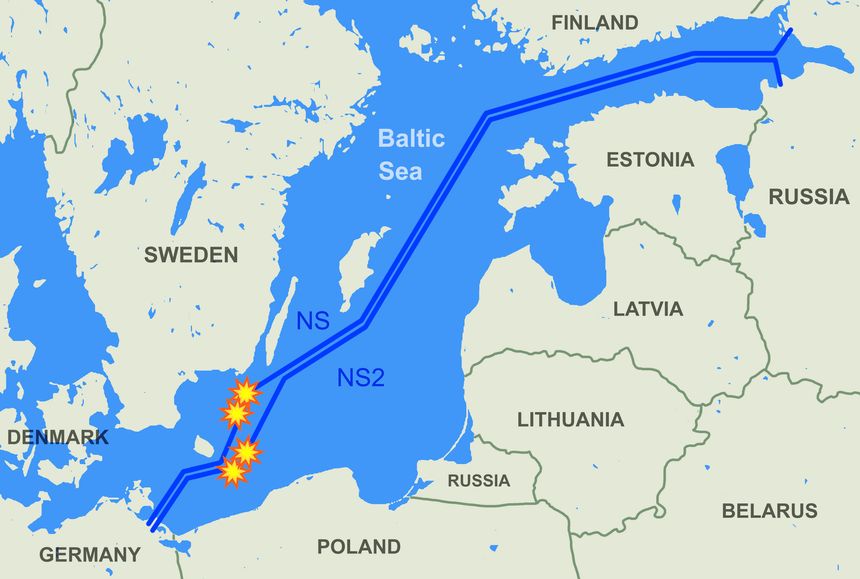
On 26 September 2022, a series of underwater explosions tore through two of the Nord Stream gas pipelines running beneath the Baltic Sea, rendering them inoperable. It swiftly became apparent that some type of directional charge had been used to sabotage the pipelines, which are one of the most significant pieces of European energy infrastructure. Criminal investigations were opened in Germany, Sweden, and Denmark. Responsibility has never been formally admitted, however the attack occurred against the context of the war in Ukraine, giving rise to several likely suspects, including state and sub-state actors.
While the geopolitical fallout played out in public, a parallel drama unfolded in the English Commercial Court. Nord Stream AG, the Swiss-registered operator of the NS1 pipelines and majority-owned by Gazprom, brought an insurance claim against its insurers Lloyd's Insurance Company S.A., representing the primary-layer insurers, and Arch Insurance (EU) DAC, representing the excess-layer insurers) for losses arising from the damage.
In a 96-page judgment handed down on 6 July 2026, Dame Clare Moulder DBE ruled firmly in favour of the insurers, dismissing the claim in its entirety.
The Core Legal Issues
Three interconnected questions dominated the trial.
1. Did the War Exclusion Apply?
The insurers' primary argument was that the damage fell within Exclusion 2.i of the policies, which excluded loss or damage “directly or indirectly occasioned by, happening through, or in consequence of war (whether war be declared or not), invasion, acts of foreign enemies, hostilities, civil war, rebellion, revolution, insurrection, military or usurped power...”
It was common ground between the parties that the conflict between Russia and Ukraine which began on or around 24 February 2022 satisfied the definition of “war” under the policies. The key battleground was causation: what degree of connection between the war and the sabotage was required for the exclusion to bite?
The Court concluded that the phrase “directly or indirectly occasioned by, happening through, or in consequence of war” sets a broad causal test — much broader than the proximate cause standard that ordinarily applies in insurance law. A cause need only be “significant” in the sense of being “noticeable” or “specifically accountable.” The Claimant’s submission that a higher threshold was required was rejected.
2. Does the Exclusion Cover All Potential Perpetrators?
Geopolitical experts Dr Less and Dr Donald agreed that there were only three realistic candidates for the sabotage: Russia, the United States, or Ukraine (including potentially a Ukrainian sub-state actor).
Rather than determine which perpetrator was most likely, the Court asked a different question: if any of those actors had carried out the sabotage, would the war have been a significant cause of their actions? The answer was yes in each case:
- Ukraine: Even the Claimant's own geopolitical expert, Dr Less, accepted that if Ukraine perpetrated the attacks, part of its motivation would have been “a wish to strike a blow against Russia for its February 2022 invasion” and that the attacks would constitute “part of their overall war effort.” The Court found that the war fundamentally changed Ukraine's calculus, providing both a new motive (retaliation) and removing the previous restraint (fear of provoking further Russian escalation).
- Russia: If Russia was the perpetrator, its motive would have been to punish Germany for its dramatic post-invasion policy shift, the Zeitenwende which was the sweeping package of punitive sanctions, military support for Ukraine and diplomatic isolation following Russia's February 2022 invasion. Both experts agreed that before 24 February 2022, Russia had no motive to destroy the pipelines.
- The United States: Dr Less accepted that if the US carried out the sabotage, “that would have been consequent upon a change of policy that arose in consequence of the Russian invasion” and that the motivation would have been “essentially threatening Russia about the consequences if it continues the war.”
The Court concluded that whichever of the potential perpetrators carried out the sabotage, the war would have been a "significant" cause of their actions. The damage was therefore “directly or indirectly occasioned by, happening through, or in consequence of war” within the meaning of Exclusion 2.i.
3. Did the Policy Structure Override the Exclusion?
Nord Stream argued that the policies incorporated the Institute Clauses for Builders' Risks (“ICBR”) and the Institute War Clauses Builders' Risks (“IWCBR”) (together, the “Institute Clauses”), and that those clauses (which positively grant cover for war risks), should take precedence over the war exclusion.
The Court rejected this argument comprehensively, finding that:
- the ICBR was not the means of providing the primary insuring clause in the policies;
- the ICBR, as incorporated, was limited to property under construction or repair;
- the IWCBR was limited to floating assets; and
- the damage to the pipelines did not fall within the scope of the cover granted by the IWCBR.
In short, the Institute Clauses were designed for vessels and construction projects, not operational fixed infrastructure such as subsea pipelines. The Court declined to rewrite those clauses finding that the cover arose from an implied all-risks term in the main policy, not from the Institute Clauses.
General Condition 9 (the Deliberate Damage clause), which Nord Stream argued provided a broad carve-back from the war exclusion, was found on its proper construction to be limited to damage caused by governmental measures to prevent or mitigate pollution and not a general override of the war exclusion.
The Dent
A subsidiary but significant dispute concerned a dent of approximately 0.8m by 0.5m on NS1 Line 2, located some 93 metres from the rupture damage to Line 1. Nord Stream argued that the cause of this dent was unknown, potentially an anchor strike and therefore not covered by the war exclusion even if the ruptures were. The insurers argued it was caused by the same explosive attack.
After an exhaustive review of competing expert scientific evidence, the Court found on the balance of probabilities that the dent was caused by an explosion forming part of the same attack. Key factors included its location close to a welded field joint (the same placement strategy used for the confirmed explosive charges); a crater to the south of the dent consistent with an explosion; the presence of metal fragments bearing traces of RDX explosive; and splayed steel reinforcement bars, all consistent with a shaped charge that had dislodged from its original position before detonating. The anchor-drop theory advanced by Nord Stream's own pipeline expert was accepted to be “extremely unlikely” and eliminated.
The Decision
The Court found that the damage to the pipelines (both the ruptures and the dent) was “directly or indirectly occasioned by, happening through, or in consequence of war” and was therefore excluded from cover by Exclusion 2.i of the policies. Nord Stream's insurance claim therefore failed in its entirety.
Why This Judgment Matters
For the insurance market, this case is a significant marker on where the line falls in war exclusion clauses. The Court confirmed that a very broad causal test applies, far looser than proximate cause, and that an exclusion can bite even where the perpetrator is not formally a belligerent, the damage occurs away from a battlefield, and the target is civilian infrastructure. Insurers drafting and pricing offshore energy policies will take note.
For policy drafting, the case highlights the dangers of bespoke and hybrid policy wordings. The Court noted repeatedly that the Nord Stream policy was "atypical" and "highly bespoke," written on an offshore construction form for an operational pipeline. It was a combination that generated layers of interpretive difficulty.
On expert evidence, the judgment contains pointed criticism of the Claimant's expert witnesses. The geopolitical expert instructed by Nord Stream was found to have sought to minimise the connection between the war and the sabotage, and his evidence was given reduced weight. Nord Stream's engineering expert was found at times to have given speculative answers and to have failed to disclose clearly the limits of his own expertise. These findings serve as a reminder that Courts will scrutinise whether experts are genuinely assisting the Court or advocating for their instructing party.
A Final Note
This is a judgment about insurance law, exclusion clauses, policy construction, and the burden of proof. But it sits against a backdrop of one of the most dramatic acts of infrastructure sabotage in modern history. For practitioners advising energy companies, insurers, or sovereign states on risk, it repays careful reading.
If you would like to discuss the implications of this case, please contact our Insurance Disputes team.
/Passle/68ee0ab18676b883b68d6972/MediaLibrary/Images/2026-09-09-08-44-15-878-6aa11c5fc35f33cd3303c3ce.jpg)
/Passle/68ee0ab18676b883b68d6972/MediaLibrary/Images/2026-09-08-17-12-13-876-6aa041ed8307ddbad283d7a4.jfif)
/Passle/68ee0ab18676b883b68d6972/SearchServiceImages/2026-09-08-08-21-54-807-6a9fc5a2ea10f1c465083b70.jpg)
/Passle/MediaLibrary/Images/2026-06-16-11-09-13-356-6a312ed903345ef073ffd87b.jpeg)