



A scrap metal trader’s cover was avoided after a string of undisclosed fires came to light following two major fires on board the LOWLANDS MIMOSA. The decision in Cometsambre SA v Lloyd's Insurance Company SA HIG 5321 [2026] EWHC 1837 (Comm) is a useful, practical illustration of how far an insured's disclosure duty really stretches under the Insurance Act 2015 (“IA”) and of how little comfort ‘it never led to a claim’ provides.
At a glance
• The Commercial Court held that Lloyd's was entitled to avoid a Charterers' Liability and FDD policy because the insured, a Belgian scrap metal dealer, failed to disclose five fires in its cargoes in the eighteen months before its 2022 renewal.
• None of the undisclosed fires had led to a claim. The Court held that was irrelevant, incidents capable of giving rise to a claim must be disclosed even if no claim in fact follows.
• The insured's arguments that underwriters had been put on notice, were presumed to know of the risk, or had waived disclosure, all failed. The burden of fair presentation sits squarely with the insured.
• The insurer's evidence that it would not have renewed on any terms was accepted, notwithstanding the usual judicial caution about "post-claim underwriting" hindsight evidence.
What happened
Cometsambre SA (“Cometsambre”), a Belgian scrap metal dealer, had chartered vessels since 2008 to ship scrap metal cargoes from Ghent, Belgium. Cometsambre was insured under a Charterers' Liability (“C/L”) and Freight, Demurrage and Defence (“FDD”) policy placed through the coverholder AMICA on behalf of Lloyd's Insurance Company SA HIG 5321. The cover had been renewed on largely unchanged terms every year.
At the outset, Cometsambre had described its cargo as clean meaning it was “non-oily/non-radioactive/non-dangerous” shredded steel scrap, consistent with recognised ISRI grading specifications. On that basis, the cargo would ordinarily be treated as a low-hazard ‘Group C’ cargo under the IMSBC Code which should be “non-combustible or has a low fire risk”.
Between May 2020 and October 2021, however, Cometsambre experienced five fires involving its scrap: three onboard chartered vessels and two on the quayside, after twelve years without any comparable incident. Cometsambre did not submit claims following the fires, and the fires were not disclosed to AMICA or Lloyd's.
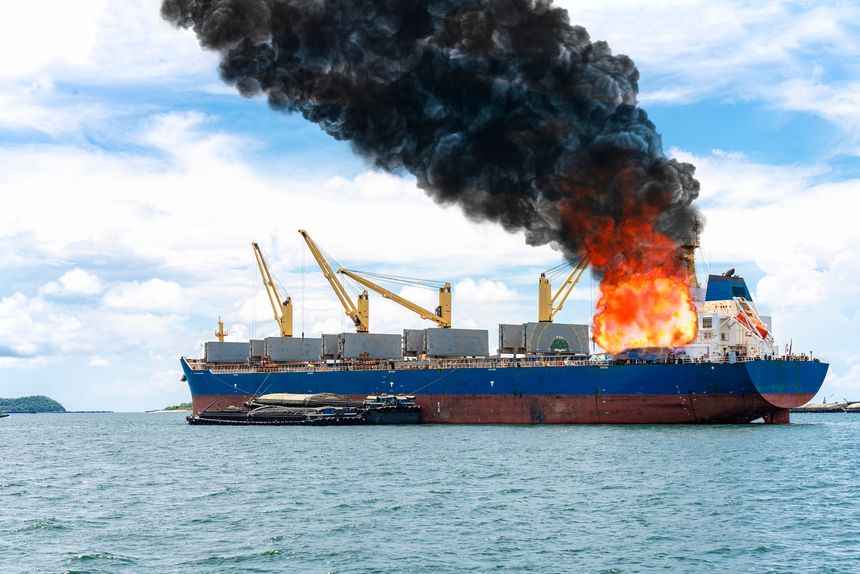
In June 2022, two fires broke out on board the LOWLANDS MIMOSA, causing significant damage to the vessel and prompting a substantial charterparty claim against Cometsambre. When Cometsambre sought indemnity under the C/L policy, Lloyd's declined and purported to avoid the 2022 renewal, on the basis that Cometsambre should have disclosed the earlier fires and had breached its duty of fair presentation of the risk under s3 IA.
The legal question
S3(4) IA mandates that an insured must disclose every material circumstance it knows or ought to know before entering into a contract of insurance, including renewal, since each renewal is treated as a new contract. Pursuant to s7(3) IA, a circumstance is material if it would influence a prudent insurer's judgment on whether to take the risk and on what terms. S3(5) IA stipulates that an insured does not have to disclose a circumstance the insurer already knows, is presumed to know, or has waived its right to be told about, or where the insured has given enough information to put the insurer on notice that further enquiries are needed.
Cometsambre accepted that the fires had not been disclosed but argued that: (1) they were not material, (2) that AMICA had effectively been put on notice or was presumed to know of the risk, (3) that AMICA had waived any right to that information, and (4) that disclosure would not in any event have changed AMICA's decision to write the risk.
What the Court decided
Materiality
The Court accepted expert evidence by Mr Howe in which he confirmed that a prudent Charterers' Liability underwriter would want to know of every fire on board a chartered vessel, whether or not it gave rise to a claim, because fire on board is a "paradigm example" of an incident capable of generating a large liability claim against the charterer. Quayside fires in stockpiled scrap awaiting loading were treated no differently, since a fire could just as easily have occurred once the cargo was on board.
Critically, the fact that none of the five fires led to a claim did not make them immaterial. The Court accepted that waiting for a claim to crystallise and then treating such incidents as disclosable would place underwriters in a precarious position, and that no market practice supported such an approach. What mattered was the pattern: twelve years without incident, followed by five fires in eighteen months, which the Court found indicated a material change in Cometsambre's risk profile regardless of whether the underlying cause of the fires had been identified.
Was Lloyd's on notice, presumed to know, or taken to have waived disclosure?
Cometsambre argued that AMICA should have known the general fire risks of the scrap metal trade, and that its own failure to request updated questionnaires, loading surveys, or further risk information at renewal amounted to being put on notice, or a waiver of the right to disclosure. The Court firmly rejected this, describing it as an impermissible bid to reverse the burden of ensuring a fair presentation, which rests primarily on the insured. Because Cometsambre's cargo had originally been presented as clean and low-risk, AMICA was not shown anything that would have put a prudent insurer on notice that the pattern of fire incidents had changed. Nor could AMICA be presumed, as a matter of common or market knowledge, to know of fires that had never been reported to it. The absence of a renewal questionnaire, and AMICA's practice of only referencing claims history at renewal, likewise did not amount to a waiver of the duty to disclose non-claims incidents.
Inducement
Finally, the Court had to decide whether, on a fair presentation, Lloyd's would not have written the risk at all, or would have done so on different terms. AMICA's underwriter gave evidence that he would not have renewed the policy on any terms and at any premium. AMICA's underwriter went on to state that premium income on this class of business was too low to justify the exposure a pattern of fires represented and he “would not have been interested in the business at all.”
The underwriting evidence further clarified that the ratio between the premium and the cost of the survey affected the willingness to underwrite the risk. Where the premium was low, at around $7,000–$8,000, and each survey cost approximately $3,000–$4,000, it made no economic sense for the underwriter to accept a risk profile with that frequency of incidents. In addition, the commission earned on such policies would ordinarily not exceed a few hundred dollars. The underwriter emphasised that “for a few hundred dollars per year I cannot have my claims people deal with five claims.”
The Court was alive to the usual caution around this kind of "post-claim underwriting" evidence, where an underwriter looking back may convince himself, honestly but wrongly, that he would have declined the risk. Having tested that evidence carefully with “healthy scepticism”, including by comparing Lloyd's more forgiving treatment of a different insured's isolated, explained fire incidents, the Court found the underwriter's evidence reliable and accepted that Lloyd's would not have renewed on any terms. Lloyd's was therefore entitled to avoid the policy and return the premium, and Cometsambre's claim was dismissed.
What this means in practice for insureds
This decision is a clear signal to policyholders across sectors where operational incidents are common but claims are not, that the fair presentation duty is not simply a ‘claims history’ exercise. A handful of practical points follow.
First, disclose incidents, not just claims. If an event is the sort of thing that could plausibly result in a claim against you, even if, on this occasion, it did not, a prudent insurer will generally want to know about it. Waiting to see whether a claim eventually materialises before deciding whether something is disclosable is exactly the approach the Court rejected.
Second, watch for a change in your own risk profile, not just isolated events. A single incident, viewed alone, may seem immaterial. A cluster of similar incidents after a long period without any can itself be the material fact that signals to an underwriter that something about the risk has changed. Insureds should review their own incident records at each renewal with this pattern-level question in mind, not just a checklist of reportable claims.
Third, do not rely on the insurer's silence or lack of questions. An absence of a fresh proposal form, updated questionnaire, or repeated requests for information at renewal is unlikely to be read as the insurer accepting that it does not need, or does not want, to know about developments in the risk. The burden remains on the insured to positively disclose material circumstances, and gaps in the insurer's own follow-up will rarely amount to a waiver.
Fourth, review how your risk was originally presented. If your risk was described to insurers at inception as low-hazard, clean, or otherwise benign, that initial presentation continues to shape what a prudent insurer is taken to expect for the lifetime of the relationship. Any material departure from that picture including through a changed pattern of incidents should be flagged at the next renewal, even where the original presentation was accurate at the time it was given.
Finally, expect underwriters' inducement evidence to be tested, but not automatically discounted. Insureds should not assume that an underwriter's evidence that they would have declined the risk will be dismissed as self-serving hindsight. Where that evidence is coherent, consistent with the insurer's known appetite and pricing for the class of business, and corroborated by independent expert evidence, courts are prepared to accept it.
The bottom line
For any insured operating in a sector where minor incidents are relatively frequent, this case is a reminder to treat fair presentation as an ongoing discipline rather than a box to tick only when a proposal form lands on the desk. A pattern of incidents that individually seem unremarkable can, taken together, be exactly the kind of information a prudent insurer would want before agreeing to renew and failing to volunteer it carries real consequences.
This unwelcome decision for policyholders underlines the importance of presenting a risk fairly. It may also give rise to claims against insurance brokers who have failed to advise their clients of their duty of fair presentation of risk.
If you have any questions, please contact a member of Edwin Coe's Insurance Disputes Team.
/Passle/68ee0ab18676b883b68d6972/MediaLibrary/Images/2026-09-09-08-44-15-878-6aa11c5fc35f33cd3303c3ce.jpg)
/Passle/68ee0ab18676b883b68d6972/MediaLibrary/Images/2026-09-08-17-12-13-876-6aa041ed8307ddbad283d7a4.jfif)
/Passle/68ee0ab18676b883b68d6972/SearchServiceImages/2026-09-08-08-21-54-807-6a9fc5a2ea10f1c465083b70.jpg)
/Passle/MediaLibrary/Images/2026-06-16-11-09-13-356-6a312ed903345ef073ffd87b.jpeg)